Meydan Free Zone vs IFZA: Which Is Better for Your Business?
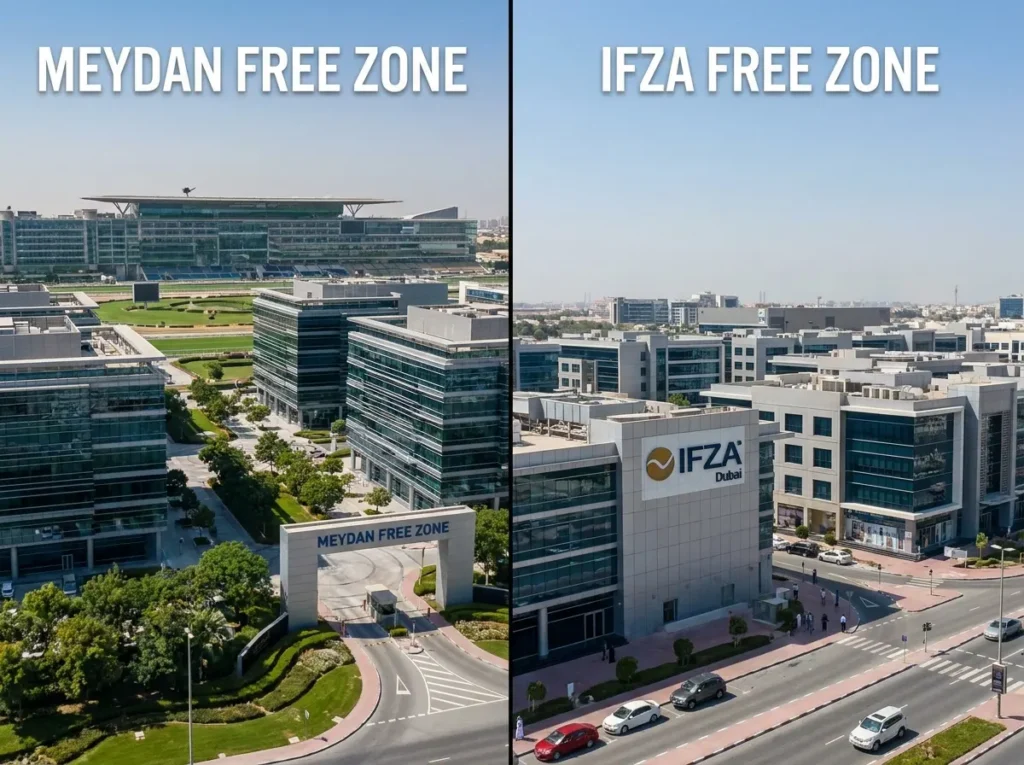
Meydan Free Zone and IFZA are close enough in price that the real difference between them is not cost, it is fit. Meydan starts from around AED 12,500 and IFZA from around AED 12,900, both offer flexi-desk packages, digital registration, and 100% foreign ownership, and both can have your license issued within three to five business days. If you are choosing purely on the headline price, you will not find much daylight between them.
Where they actually diverge is in visa economics at scale, activity structure, and how each free zone positions your company to banks, clients, and, in Meydan’s case, the UAE mainland market. A consultancy planning to stay lean with one or two visas will weigh these free zones differently than a trading business planning to sponsor five employees within its first eighteen months.
This guide compares Meydan Free Zone vs IFZA head-to-head on cost, visa packages, business activities, setup process, and market positioning, so you can decide which one actually fits your business rather than picking based on whichever free zone you heard about first.
Meydan Free Zone vs IFZA at a Glance
| Factor | Meydan Free Zone | IFZA |
|---|---|---|
| Entry-level licence cost | From approximately AED 12,500 | From approximately AED 12,900 |
| Activities per licence | Up to 3 activity groups from 2,500+ activities | Multiple activities from 1,500+ activities |
| Setup timeline | 3–5 business days, fully remote | 3–5 business days, mostly remote |
| Establishment card | Approximately AED 2,000 (1st year) | Approximately AED 3,000 |
| Visa cost (approximate, all-in) | Approximately AED 3,500–4,500 per person | Approximately AED 3,000–4,500 per person |
| Location | Meydan One, Nad Al Sheba (central Dubai) | Dubai Silicon Oasis |
| Mainland access | Free zone LLCs can apply for a DET mainland permit without a separate mainland licence | Generally requires a dual licence or distributor arrangement |
| Best known for | Dubai-address branding at a competitive price | Broad activity list and cost efficiency at higher visa counts |
Both figures are general market ranges and change periodically; always confirm current package pricing directly with the free zone authority or your adviser before budgeting.
Cost Comparison: Meydan vs IFZA in Practice
At the entry level, the difference between Meydan and IFZA is marginal, generally a few hundred dirhams either way on the base licence. The real cost difference shows up once visas enter the picture.
Meydan Free Zone visa costs typically break down into a visa allocation/registry fee, a processing fee, and, for shareholders, an investor visa fee, which together tend to land in the AED 3,500–4,500 per person range once medical testing and Emirates ID are included. Meydan also uses optional add-on service bundles (for banking introductions, visa processing, and accounting) rather than folding everything into the base licence, so founders can start lean and layer in services as needed, or pay more as those services are used.
IFZA structures its pricing primarily around visa-inclusive package tiers, zero-visa, one-visa, two-visa, and up through higher tiers, with each tier priced as a bundle. This makes IFZA’s total cost more predictable upfront for founders who know their visa needs in advance, and it tends to become more cost-efficient than Meydan once you are sponsoring three or more visas.
Practical takeaway: For a solo founder or a two-person team, Meydan and IFZA land in a similar cost range. For a small team planning to scale past three visas within the first year or two, it is worth requesting a full multi-visa quotation from both, since IFZA’s bundled tiers often work out more efficient at that scale.
Business Activities: Which Offers More Flexibility?
Meydan permits up to three activity groups under a single licence from a list of more than 2,500 approved activities spanning 17 categories, including ICT, professional services, trading, manufacturing, and financial services. This structure suits businesses that genuinely operate across a few related activities, consulting plus training, for example, without paying for multiple licences.
IFZA offers a similarly broad list, with more than 1,500 approved activities across professional, commercial, industrial, and holding categories, and also allows multiple activities to be combined under one licence.
Practical takeaway: Both free zones comfortably cover the vast majority of consulting, trading, e-commerce, and digital business models. If your specific activity is a narrow edge case, checking both activity lists directly before comparing price is worth the ten minutes it takes.
Setup Process: Speed and Convenience
Both free zones are built around fast, largely digital registration:
- Meydan issues licences within 3–5 business days, with the full process completable remotely; company formation is described as one of the more paperwork-light options among Dubai free zones
- IFZA typically grants initial approval within one to two business days and issues the trade licence three to five business days after payment, also largely remote, with in-person presence generally only required for visa medical testing and biometrics
Practical takeaway: Neither free zone has a meaningful speed advantage over the other at the license-issuance stage. The bigger time variable for both is how quickly you supply clean, complete shareholder documentation.
Market Positioning and Credibility
This is where the two free zones genuinely differ. Meydan’s location in Meydan One, Nad Al Sheba, places it firmly within Dubai’s central business geography, close to Downtown Dubai and Business Bay, and its companies are structured as MoFA-approved free zone LLCs, accredited by the Dubai Chamber of Commerce. Meydan free zone companies can also apply for a DET mainland permit to access UAE mainland markets without needing a separate mainland licence, which is a meaningful advantage for businesses expecting a mix of international and local UAE clients.
IFZA, based in Dubai Silicon Oasis, is well recognised among founders and setup consultants specifically for its cost efficiency and broad activity list, but does not carry the same central-Dubai address positioning as Meydan, and generally requires a dual licence or distributor arrangement for meaningful UAE mainland trading.
Practical takeaway: If your clients or investors are likely to notice or care about your registered address, or if UAE mainland access matters to your growth plan, Meydan has a structural edge. If address branding and mainland access are not priorities and your focus is pure cost efficiency at scale, IFZA holds its own, particularly for larger visa counts.
Which Should You Choose?
- Choose Meydan Free Zone if: you want a recognisable central-Dubai address, you may need a mainland permit route later without switching free zones, or your activity fits comfortably within three activity groups
- Choose IFZA if: your priority is maximum cost efficiency, particularly once you are sponsoring three or more visas, and you do not need mainland market access or premium address positioning
- Consider a full quotation from both if: you are genuinely undecided, since the real difference in total first-year cost, once visas, establishment cards, and add-on services are included, can vary meaningfully from the headline licence price alone
EXPERT INSIGHTS
Common mistake #1: Comparing only the base licence fee. Founders frequently compare Meydan and IFZA using the entry-level licence price alone, then discover the real cost difference only appears once visas, establishment cards, and optional service bundles are added on both sides.
Common mistake #2: Ignoring mainland access needs upfront. A founder who signs up with IFZA and later discovers they need meaningful UAE mainland trading access may face a more complex retrofit than a founder who chose Meydan for its DET mainland permit pathway from the start.
Common mistake #3: Overvaluing address prestige for a business that doesn’t need it. Not every business benefits from a central-Dubai address. A B2B SaaS company selling internationally, for instance, may find IFZA’s cost efficiency more valuable than Meydan’s location advantage.
Best practice: Request a like-for-like quotation from both free zones based on your actual visa count and activity, rather than comparing published starting prices, which represent the cheapest possible configuration on each side.
Emerging trend: Both free zones have moved toward modular, add-on service pricing (banking introductions, visa processing, accounting) rather than all-inclusive packages, which rewards founders who compare total realistic first-year cost rather than the base licence fee alone.
UAE REGULATORY & MARKET CONSIDERATIONS
Both Meydan and IFZA companies are taxable persons under UAE Corporate Tax law (Federal Decree-Law No. 47 of 2022), and both can qualify for a 0% Corporate Tax rate on qualifying income if they meet the conditions of a Qualifying Free Zone Person, while non-qualifying income is taxed at the standard 9% rate. The Ministry of Finance’s corporate tax overview confirms this 0% treatment applies specifically to qualifying income, not automatically to all revenue.
This is where Meydan’s mainland permit pathway deserves closer attention. A Meydan company that earns a meaningful share of income through a DET mainland permit needs to assess how that income interacts with its Qualifying Free Zone Person status, since non-qualifying, mainland-sourced income is subject to strict limits under the qualifying conditions. An IFZA company that pursues UAE mainland access through a distributor or dual license faces a broadly similar consideration. In both cases, the free zone choice does not remove the need to plan your Corporate Tax position around your actual revenue mix.
For businesses weighing address credibility specifically for banking purposes, it is worth noting that UAE banks apply standard KYC and source-of-funds due diligence regardless of free zone; neither Meydan nor IFZA offers an exemption from that process, though a track record of dealing with a particular free zone can smooth onboarding over time. The UAE government’s official free zone business setup guide provides useful federal-level context on how free zone registration and market access rules interact before comparing individual authorities like Meydan and IFZA.
FREQUENTLY ASKED QUESTIONS
1. Is Meydan Free Zone cheaper than IFZA? They are close in price at the entry level, Meydan from around AED 12,500 and IFZA from around AED 12,900. IFZA tends to become more cost-efficient once you need three or more visas, due to its bundled package structure.
2. Which is better for a startup, Meydan or IFZA? It depends on priorities. Meydan suits startups that want a central-Dubai address or may need UAE mainland access later. IFZA suits startups prioritising maximum cost efficiency, particularly at higher visa counts.
3. Can a Meydan Free Zone company trade with UAE mainland clients? Meydan free zone LLCs can apply for a DET mainland permit to access UAE mainland markets without a separate mainland licence, which is a notable advantage over free zones that require a distributor or dual licence arrangement.
4. How many business activities can I combine under one licence? Meydan allows up to three activity groups from over 2,500 approved activities. IFZA also allows multiple activities under a single licence from a list of over 1,500 approved activities.
5. How long does it take to set up a company in Meydan or IFZA? Both are largely digital processes with licences typically issued within three to five business days, assuming shareholder documentation is complete and accurate.
6. Do both free zones offer 100% foreign ownership? Yes. Both Meydan Free Zone and IFZA offer full foreign ownership, consistent with the wider UAE free zone system.
7. Which free zone is better for a business that plans to hire several employees? IFZA’s bundled visa-tier packages tend to become more cost-efficient than Meydan’s per-visa fee structure once you are sponsoring three or more employees, though it is worth requesting a specific quotation for your exact headcount from both.
8. Do Meydan and IFZA companies pay the same UAE Corporate Tax? Both are subject to the same federal Corporate Tax rules. Companies meeting Qualifying Free Zone Person conditions on either free zone can access a 0% rate on qualifying income, while non-qualifying income is taxed at 9%, so the tax treatment itself does not favour one free zone over the other.
KEY TAKEAWAYS
- Meydan Free Zone and IFZA are closely priced at the entry level, from roughly AED 12,500 and AED 12,900 respectively
- IFZA’s bundled visa-tier packages generally become more cost-efficient than Meydan once you need three or more visas
- Meydan offers a stronger central-Dubai address and a DET mainland permit pathway that IFZA does not directly replicate
- Both free zones allow multiple business activities under a single licence and complete registration largely remotely within 3–5 business days
- Neither free zone changes your UAE Corporate Tax position; Qualifying Free Zone Person status depends on your income mix, not which free zone you choose
- The better choice comes down to your visa growth plan, whether address branding or mainland access matters, and your specific business activity, not the headline license price
Meydan Free Zone and IFZA are both credible, cost-effective options for setting up a company in Dubai, and neither is objectively “better” in isolation. Meydan holds the edge on address positioning and mainland market access; IFZA holds the edge on cost efficiency once your visa count grows. The right decision comes down to matching the free zone to your actual growth plan rather than the headline license price, which barely differs between them.
Because package pricing, visa fees, and Corporate Tax qualifying conditions can change, treat this comparison as a starting point rather than a final quotation, and confirm current terms with Meydan, IFZA, or a licensed adviser before registering.
At INFICO, we help businesses choose the right structure and navigate the UAE company formation process.
If you would like a side-by-side quotation for your specific activity and visa needs, our advisers can compare Meydan, IFZA, and other UAE free zones against your actual business plan and help you choose with confidence.
Get in touch with Infico UAE:
Email: info@infico.ae
Phone: +971 508786023